
The Queen’s Journal – #29
This week in robotics: Consequence-aware AI systems reshaping industrial decision-making, the challenge of turning robotics data into scalable AI infrastructure, Germany’s automation slowdown.

What You Should Know Before Buying a Robot
Robot reach and working envelope matter more than you think. Robot reach is often one of the first specifications compared when selecting a robot. It is simple to understand and easy to measure. Reach defines the maximum distance the robot arm can extend from its base to the tool centre point. However, reach alone does not determine whether a robot can perform a task effectively within a real production environment.
What truly matters is the usable workspace. The usable workspace is the portion of the robot’s working envelope where it can operate reliably, safely, and with the correct orientation. At the limits of reach, the robot may be stretched, slower, or mechanically constrained. It may technically touch a point but be unable to approach it at the required angle or with sufficient stability for production work. Mounting position, pedestal height, tooling length, joint limits, safety zones, and surrounding equipment all reduce the practical working area.
Choosing incorrect reach can restrict cell layout, increase cycle time, or limit flexibility for future changes. A robot that is too small forces design compromises. A robot that is unnecessarily large increases cost and footprint without adding value. The goal is not maximum reach, but appropriate reach for the real application.
Before deciding on robot reach, check:
What is the farthest point the robot must access during normal production?
From which direction does the robot need to approach the part?
Will the robot need to reach over conveyors, fixtures, or guarding?
Where will the robot be mounted, floor, pedestal, wall, or ceiling?
Choosing the right reach is not only about whether the robot can touch the part. It is about ensuring efficient layout, safe operation, and long-term adaptability of the automation cell.
➔ Next edition: We will look at accuracy and repeatability, two specifications that are often confused but can directly impact quality, tolerances, and long-term process stability.
Top Robotics Updates
1 - Robots Need Consequence Awareness, Not Just Speed
Robotics systems today are faster and more capable than ever, yet many failures still happen because robots react only to the present moment. In real industrial environments, actions are often irreversible. Small mistakes can grow into downtime, product damage, or operational disruption.
Sereact is tackling this challenge with Cortex 2.0, a system designed to help robots evaluate possible outcomes before acting. It introduces decision grounded world models that allow robots to anticipate risk while keeping real time control fast and reliable.
Built from real deployment data, Cortex 2.0 separates execution from imagination so robots can simulate potential futures without slowing production. This approach supports safer decisions, improved reliability, and better long horizon performance in complex automation tasks.
👉 Read the full breakdown here: ➔ Link
Why does this matter? Physical AI is moving beyond reactive automation. Systems that understand consequences can reduce costly errors, improve collaboration with humans, and expand the range of tasks that can be automated in real industrial settings.
2 - Robotics Data Is Growing Fast. Making It Usable Is Still the Challenge
Physical AI systems generate huge amounts of data every day. Cameras, force signals, telemetry, robot logs. Collecting data is no longer the biggest issue. The real challenge is organising it, synchronising it, and turning it into something engineers can actually use for AI training, debugging, and deployment.
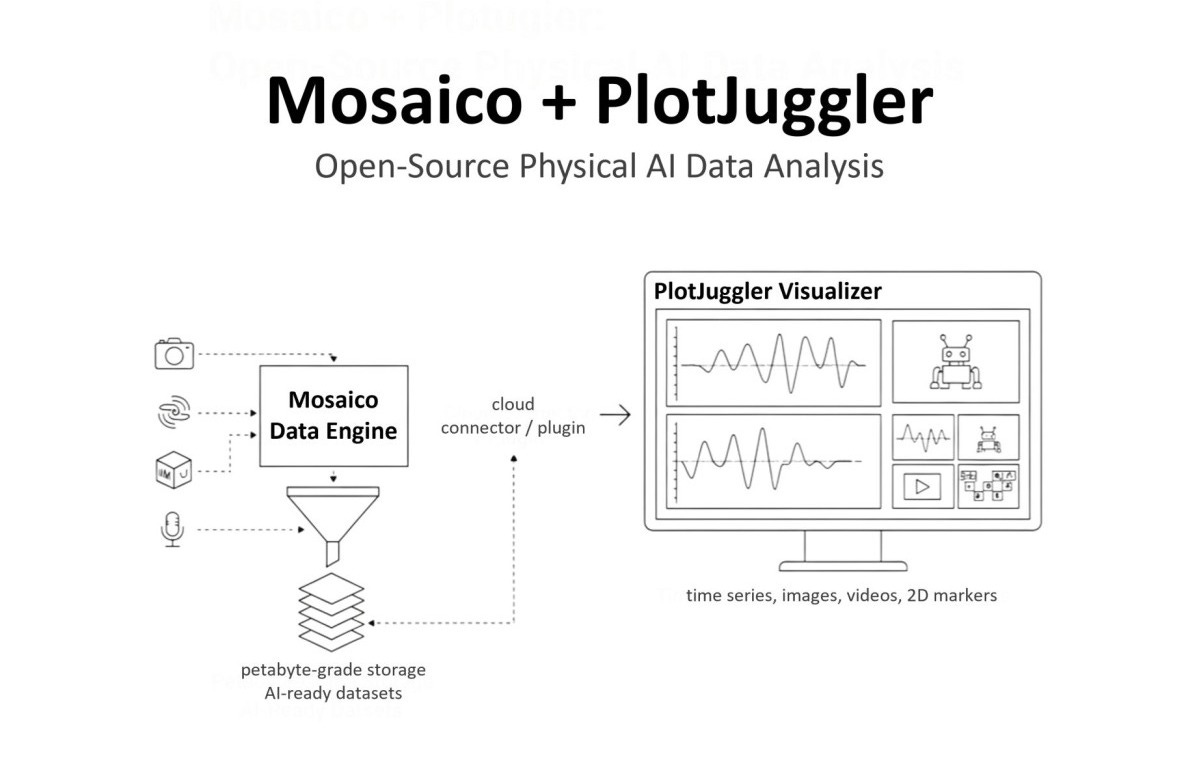
This is where Mosaico comes in. The platform focuses on turning messy robotics logs into structured, AI ready datasets so teams can move faster from experimentation to real world use.
A recent step forward is the collaboration with Davide Faconti, creator of PlotJuggler. By combining Mosaico’s data infrastructure with PlotJuggler’s visualisation tools, engineers get a smoother workflow for inspecting and understanding complex robotics data.
Why does this matter? Better data infrastructure means faster development, easier debugging, and more reliable AI systems. That is essential if Physical AI is going to scale from lab experiments to real industrial applications.
3 - Germany’s Automation Industry Faces a Challenging Phase
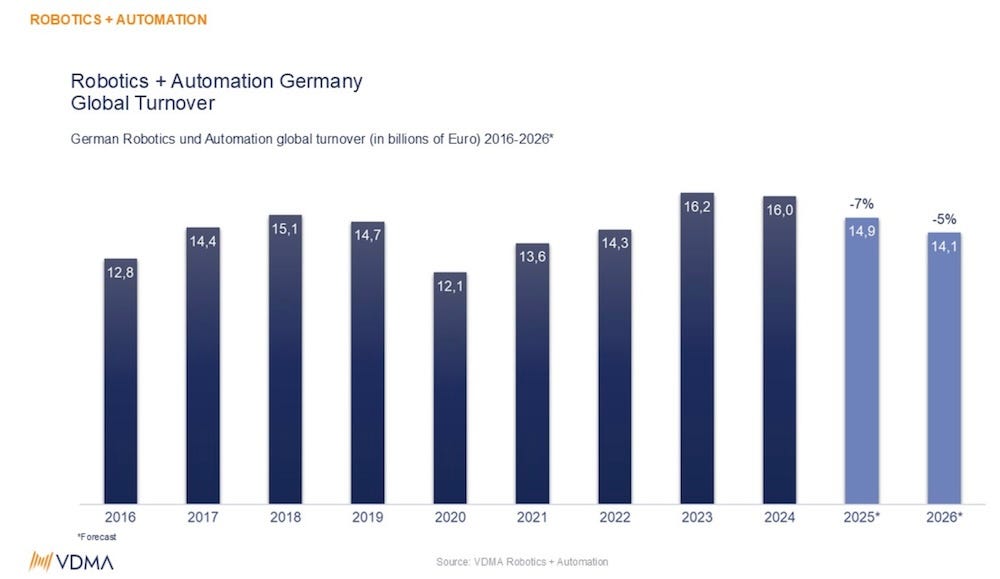
Germany’s robotics and automation industry is expected to contract again in 2026. According to VDMA Robotics + Automation, revenues are forecast to decline by around 5 %, following an estimated 7 % drop in 2025.
The sector, which represents one of the strongest industrial automation markets globally, is facing continued pressure from weak domestic demand, geopolitical uncertainty, and slower investment cycles across key manufacturing industries. While export markets and innovation remain active, the overall momentum has slowed compared to previous years of expansion.
Germany has historically been a leader in industrial automation, with strong mechanical engineering capabilities and globally recognised robot manufacturers. A continued contraction raises questions about competitiveness, investment timing, and how European automation companies position themselves in a market increasingly influenced by Asia and North America.
Why does this matter? Germany plays a central role in the global automation ecosystem. A slowdown in this market does not mean robotics is declining globally, but it does signal shifting dynamics. Investment patterns are changing. Competition is intensifying. And manufacturers may become more selective and cautious in capital expenditure decisions.
4 - Yaskawa Introduces a New Adaptive Industrial Robot Platform
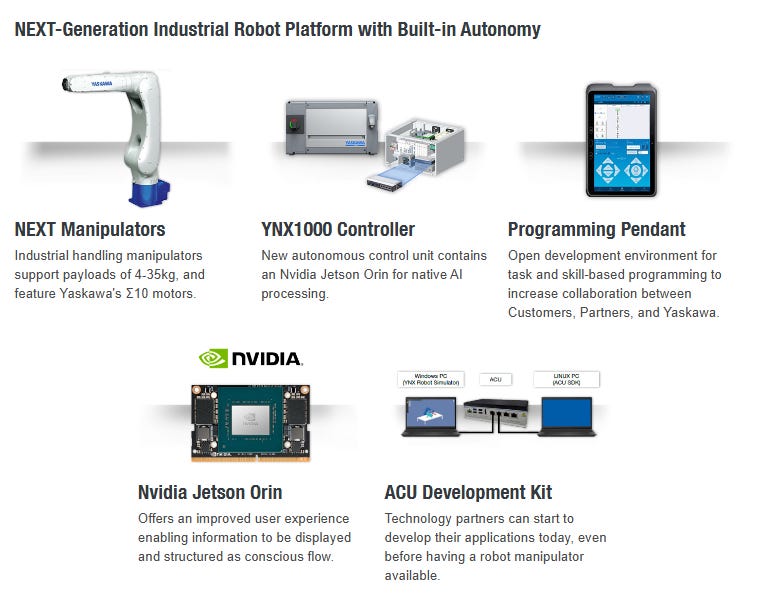
Yaskawa Motoman has introduced the MOTOMAN NEXT platform, expanding its portfolio with adaptive industrial robots designed to combine traditional motion control with AI-driven capabilities. One of the key models in this series is the NEX10, a 6-axis industrial robot with a 10 kg payload and approximately 1.1 m reach, built for flexible handling, assembly, and adaptive production tasks.
What differentiates MOTOMAN NEXT is its architecture. The platform integrates conventional robot control with an autonomous control unit powered by advanced computing hardware, enabling the use of vision systems, force sensing, and AI-based algorithms. This allows the robot to detect variation, interpret sensor data, and adjust motion in response to changes in the environment.
From a hardware perspective, the NEX10 maintains typical industrial specifications such as high repeatability and sealed protection for demanding environments. The focus of the platform is to support applications where adaptability and perception are becoming increasingly relevant in manufacturing. Learn more here: ➔ Link
5 - Top 100 Women Chief in Tech Leaders to Watch in 2026
A new industry ranking has highlighted the Top 100 Chief in Tech Leaders to Watch in 2026, celebrating influential executives and innovators across technology sectors worldwide. The list recognises leaders shaping strategic direction, driving digital transformation, and championing innovation across industries like robotics, AI, automation, software, and hardware.
These leaders were selected based on their impact in steering technology organisations, championing innovation, and influencing trends that matter for the future of industry and society. Among the categories evaluated were strategic vision, growth impact, innovation leadership, and contributions to building resilient and future-ready organisations.
The selection reflects a broader shift in how technology leadership is evaluated — not just by organisational size or revenue, but by adaptability, inclusivity, and influence on wider tech ecosystems. Leaders on this list come from major tech hubs across Europe, North America, and Asia, and represent both established executives and rising tech innovators.
👉 Full list available here: ➔ Link

Weekly Tutorial
How to Backup an ABB Robot
Losing a robot program, calibration data, or system configuration can cause serious downtime. Creating regular backups is one of the simplest and most important habits in robotics maintenance. In this tutorial, I show you how to create a secure backup on both OmniCore and IRC5 controllers in just a few minutes.
Backup Steps – ABB Robotics
➔ OmniCore Controller
Insert a USB stick into the teach pendant port.
On the teach pendant, go to Home → Settings.
Select Backup.
In the backup path, click Browse.
Choose USB as the destination.
Press Backup.
Wait until the process is complete before safely removing the USB stick.
➔ IRC5 Controller
Insert a USB stick into the teach pendant port.
On the teach pendant, go to Menu → Backup & Restore.
Select Backup Current System.
In the backup path, click the three dots ….
Choose USB as the destination.
Press Backup at the bottom right.
Wait until the backup is complete before removing the USB stick.
Good to Know:
The Biggest Doubts Nobody Sees
This week Dr. T and I talked about something many professionals feel but rarely say out loud. The doubts behind the scenes. Questions about confidence, growth, pressure, and responsibility that often stay hidden, especially in robotics, engineering, and leadership.
It is easy to show results. It is harder to talk about uncertainty. In the full conversation, we share honest reflections, practical insights, and personal experiences that many people quietly go through.
👉 Watch the full episode on my ➔ YouTube channel
She Builds. We Rise | Join Me This International Women’s Day
Engineering does not have a talent problem. It has a visibility problem. That is why on 8 March 2026 I will be joining the International Women’s Day event hosted by Your Favourite Engineer Princess Bamigboye. I am excited to be part of a conversation focused on women actively building the future of engineering, robotics, software, and product design.
I will be speaking alongside amazing women doing real work in the industry: Mojisola Alegbe in software engineering leadership, and Stephanie Asoegwu (UI/UX) in product design. This event is not only for women. It is for engineers, founders, students, and anyone who believes innovation gets stronger when more voices are involved.
📅 8 March 2026 | 🕓 4pm WAT | Free event | ➔ Register here

Want more robotics content? 🤖
Watch my videos on YouTube @TheRobotQueen
Follow me on Instagram @therobotqueen_