
The Queen’s Journal – #28
This week: AI moving closer to real industrial deployment, new humanoid robot launches, new insights shaping the future of automation, and growing visibility of women in engineering and robotics.

What You Should Know Before Buying a Robot
Payload is one of the first specifications people look at when selecting a robot, but it is often misunderstood. It is not just the weight of the part. It is the total mass the robot must carry. That includes the part, end effector, mounting plates, sensors, cabling, dress packs, fixtures, and any additional forces created during motion. If the robot must lift it, move it, accelerate it, or stop it, it counts as payload.
Choosing a robot with too little payload can lead to reduced speed, unstable motion, higher wear, and unexpected downtime. On the other hand, selecting a robot with far more payload than needed usually increases cost, energy consumption, and footprint without improving the process. The best choice balances capability with actual production requirements.
Payload also impacts cycle time and long term reliability. Robots operating close to their maximum payload often require lower acceleration and can experience higher mechanical stress. This can affect repeatability, component lifespan, and maintenance intervals. A properly sized robot typically delivers smoother motion, better accuracy, and longer service life.
Before deciding on the robot payload, check:
What is the total moving mass including tooling, cables, and fixtures?
Are dynamic forces, acceleration, or inertia being considered?
Will the product weight vary over time or across batches?
Does the payload allow margin for future changes or upgrades?
As a general recommendation, avoid running a robot continuously at its maximum payload capacity. Operating too close to the limit can reduce speed, increase wear, and shorten equipment lifespan. Allowing some margin helps protect productivity, maintain accuracy, and support long term reliability
➔ Next week: We will look at robot reach and working envelope, and why choosing the wrong reach can limit your entire cell layout.
Top Robotics Updates
1 - Generalization in Robotics Is Not Just About Bigger AI Models
Robotics systems are becoming more capable every year, yet most robots are still trained for very specific tasks. A picking robot picks. A packing robot packs. A humanoid that stocks shelves can stock shelves. But change the environment slightly, a new product shape, a different layout, an unexpected obstacle, and many systems struggle or need retraining.
Sereact is approaching this differently. Their focus is building an AI brain that allows robots to adapt continuously in real environments. Instead of learning only from success or failure at the end of a task, the system learns from every moment of interaction. Grip feedback, object behaviour, and force changes all feed into the learning loop, helping robots improve while they work.
This same AI system can power different robot types, from warehouse picking arms to humanoids stocking supermarket shelves, while sharing learning across all deployed robots.
👉 Follow Sereact here to see how this evolves
Why does this matter? Generalization is becoming a key factor for real-world robotics adoption. Systems that learn continuously from deployment can adapt faster, reduce retraining effort, and make automation more flexible across industries and environments.
2 - AI Robotics Moving from Labs to Real Industry
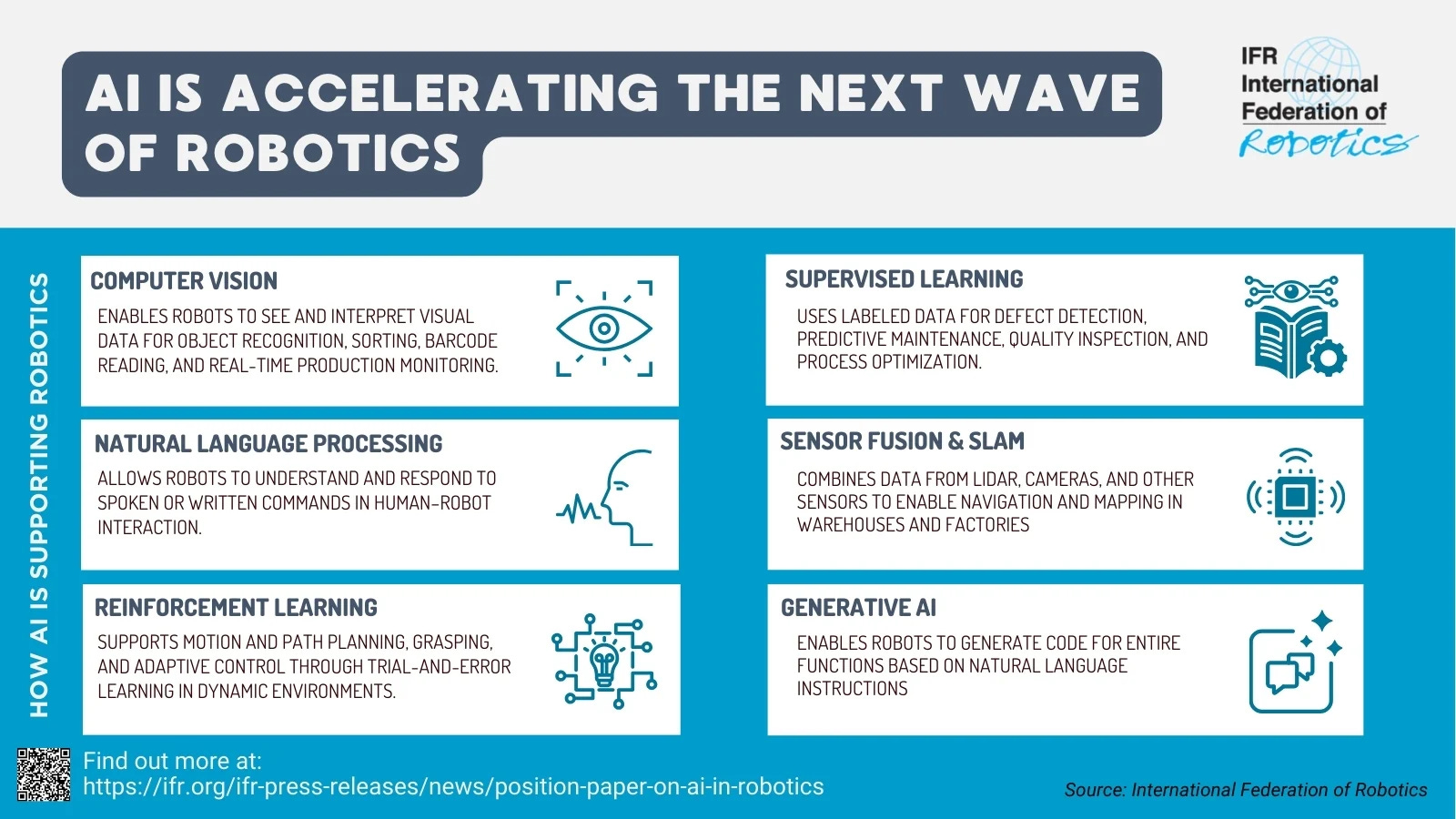
According to a recent position paper released by the International Federation of Robotics (IFR), a new generation of AI powered robots is moving from research labs into real industrial environments. The report highlights how advances in artificial intelligence, combined with growing automation demand, are accelerating this transition.
For years, AI robotics was largely limited to research projects, controlled demonstrations, or pilot applications. Today, manufacturers are beginning to deploy AI driven robots directly in production settings, where adaptability, data driven decision making, and flexibility are becoming critical competitive factors.
The IFR notes that integrating artificial intelligence into robotics improves efficiency, adaptability, and overall capability. This shift marks a move away from purely fixed programming toward systems that can analyse data, detect variations, and optimise processes in real time.
This evolution reflects a broader transformation in industrial robotics. Software, data, and AI intelligence are becoming as important as mechanical performance. For manufacturers facing labour shortages, increasing product variability, and pressure for efficiency, AI enabled robotics is quickly moving from experimentation to practical industrial use.
3 - Humanoid and Quadruped Robots Enter Commercial Pre-Orders
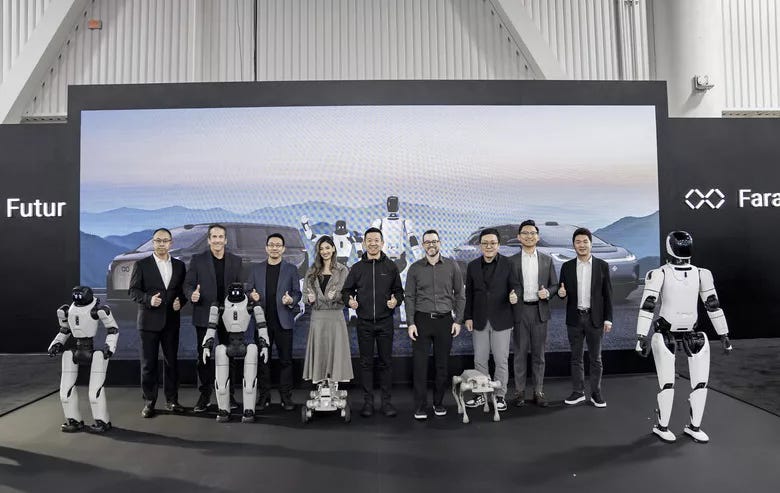
Faraday Future, known for electric vehicles, recently introduced a new robotics division and unveiled three embodied AI robots: two humanoid platforms, FF Futurist and FF Master, and a quadruped robot called FX Aegis. The announcement was made during an industry event in Las Vegas, with pre orders already open and early deliveries expected soon, according to Assembly Magazine.
The company positions these robots for real-world applications where mobility, flexibility, and human-robot collaboration are required. Humanoid robots are being explored for industrial support and service tasks, while quadruped robots are often used for inspection, monitoring, and operations in environments that are difficult for wheeled machines.
Why does this matter? From my perspective, this shows embodied AI robotics moving closer to commercial positioning, especially for industrial and service environments. It is an important step forward, but still part of a development phase. We may see selective industrial use cases first, while broader deployment will depend on reliability, cost, and proven value.
4 -Humanoid Robot Designed to Feel More Human
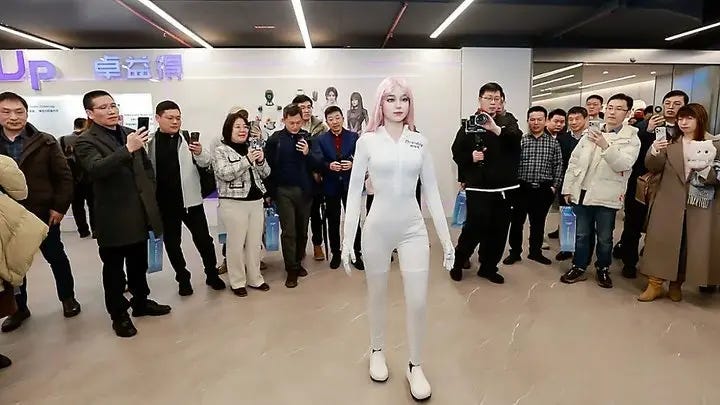
A robotics startup recently introduced a humanoid robot designed to look and feel closer to a human than most existing robotic systems. The robot features synthetic skin designed to replicate human temperature, expressive facial capabilities, and autonomous navigation supported by onboard sensors. According to early reports, the concept focuses on environments where human interaction plays a central role, such as public spaces, exhibitions, customer service settings, and potentially healthcare or assistance scenarios.
This approach reflects a growing trend in humanoid robotics where the emphasis is shifting from purely functional machines toward systems designed for social interaction. Beyond movement and task execution, developers are experimenting with appearance, gestures, facial expressions, and behavioural realism to make interactions feel more natural. While technically impressive, this direction continues to spark discussion about acceptance, usefulness, and the real added value of highly human-like machines. Learn more here: ➔ Link
Why does this matter? Beyond the technical progress, this raises broader questions about the direction of robotics. Personally, I am not fully comfortable with robots designed to closely resemble humans, especially when the purpose is not clearly functional. Robotics has always been about solving practical problems. When machines start imitating human appearance too closely, it is worth asking what the real objective is, and whether realism actually adds value or simply creates new ethical and social concerns.
5 - Robotics Meets Fashion at New York Fashion Week
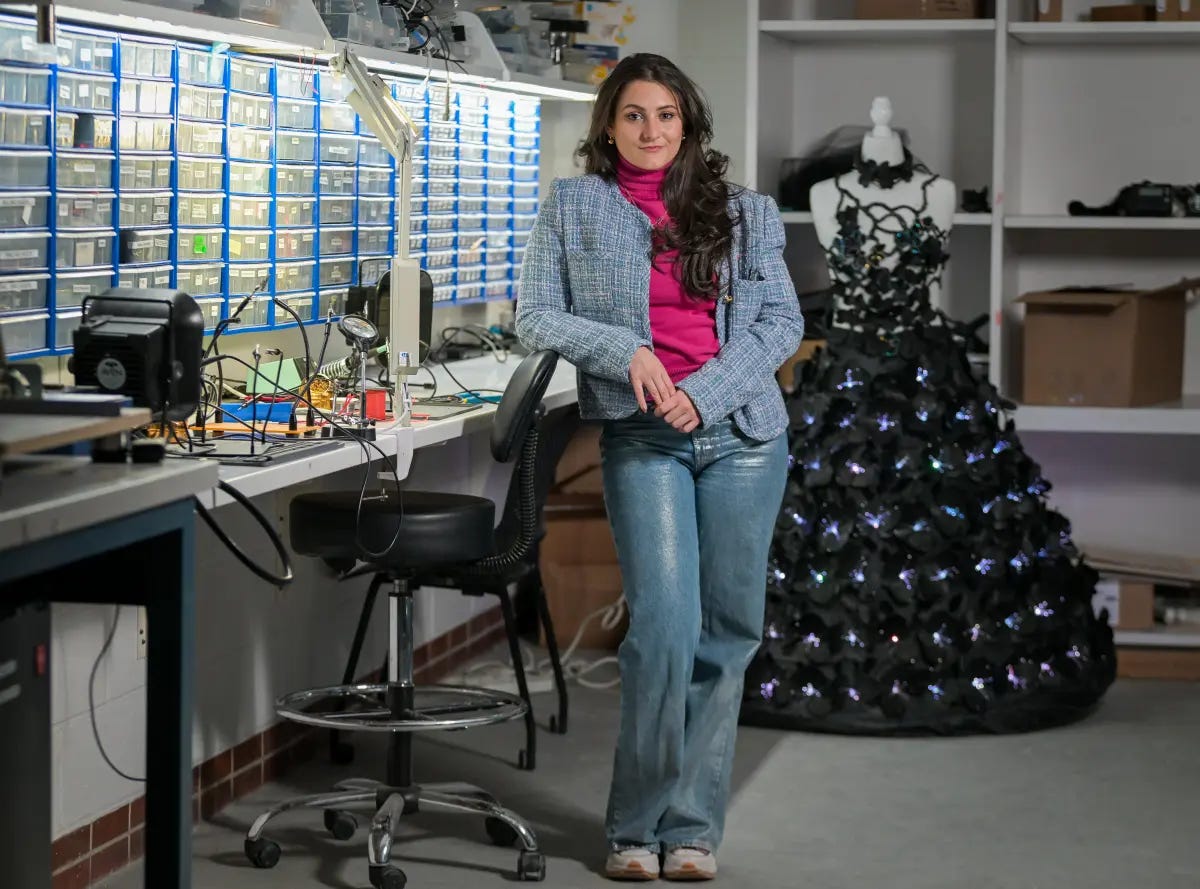
Robotics engineer and PhD researcher Anouk Wipprecht recently showcased interactive robotic garments at New York Fashion Week, highlighting the intersection between engineering, wearable robotics, and fashion design. One of the featured pieces, the “Blooming Dress,” uses embedded sensors and actuators to mechanically open like a flower when the wearer shakes someone’s hand. Another design incorporates optical fibres and stretch sensors that respond dynamically to body movement.
These projects combine robotics, electronics, materials engineering, and design, demonstrating how automation technologies are expanding beyond industrial applications into creative industries. Wipprecht’s work also aims to increase visibility for women in engineering by bringing robotics into more public and cultural spaces.
Why does this matter? Projects like this show how robotics is expanding beyond traditional industrial applications into creative and public facing environments. They also help increase visibility for engineering careers, especially for women in STEM, by showing that robotics can intersect with design, art, and everyday experiences. Visibility and representation remain important factors in attracting new talent to the field.
Weekly Tutorial
How to program a ReBel Robot?
This week’s tutorial shows how to create a simple robot program on the igus ReBeL quickly. You do not need advanced programming experience to start. The control software is intuitive and lets you teach positions directly on the robot, then turn those movements into a working sequence.
What you’ll learn
How to connect the ReBeL robot and open the control software
How to jog the robot and teach positions step by step
How to select motion types and build a complete sequence safely
How to run the program for the first time using reduced speed and safe modes
👉 Watch the full step-by-step tutorial.
Good to Know:
The Robot Queen Academy
When people talk about learning robotics, they often think about students or beginners. But in reality, many professionals already working in automation realise they still have gaps in the fundamentals. And many managers want their teams to grow their robotics knowledge without taking them away from projects for days or weeks.
That is exactly why I created The Robot Queen Academy. A structured way to learn robotics fundamentals based on real industry experience. If you want stronger foundations, more clarity, or a practical way to train your team, you can join the waitlist now to get early access and updates on the first courses coming soon.
Join the waitlist to get early access and all the details 👉The Robot Queen Academy

Job Offers:
Stay updated with the latest job opportunities in robotics and automation.
Olive Robotics: Robotics Eng & Operations Execution
Remobi: Robotics Engineer
Energy Robotics: Robot Software Engineer
Inbolt: Robotics Application Engineer
Agile Robots SE: Senior Software Engineer for Industrial Robot Control
Want more robotics content? 🤖
Watch my videos on YouTube @TheRobotQueen
Follow me on Instagram @therobotqueen_