
The Queen’s Journal – #27
This week in robotics: Open-source Physical AI infrastructure, adaptive industrial robots, major funding rounds, and the technologies shaping how automation scales in 2026.

What You Should Know Before Buying a Robot
After choosing the right level of automation, the next step is selecting the right robot type and technology. This is where many projects drift toward what looks impressive instead of what actually fits the process.
Different tasks demand different robot characteristics. Payload, reach, speed, accuracy, environmental rating, and safety features all shape how well a robot will perform in real production conditions. A robot that is technically capable but poorly matched to the application can create reliability issues, higher maintenance costs, and unnecessary integration complexity.
The key is to let the process define the technology, not the other way around. A simple pick and place task may not need advanced vision or collaborative features, while a variable, human-facing process may require flexibility and built-in safety from the start.
Before selecting a robot, check:
How much payload and reach does the task actually require?
What level of precision and repeatability is needed for quality?
What environmental conditions will the robot operate in?
How will safety and human interaction be managed in the application?
The right robot is not the most advanced one. It is the one that fits the process, scales with production, and can be supported over the full lifecycle.
➔ Next week: We’ll explore how payload choices shape cost, speed, and long-term reliability.
Top Robotics Updates
1 - Robotics Data Is Not AI Ready by Default
Robotics and Physical AI systems generate massive amounts of data, but turning that data into something usable at scale remains a major challenge. Sensor streams are asynchronous, multi-rate, and often fragmented across tools that were never designed for modern AI workflows.
Mosaico is an open source data infrastructure created to bridge this gap and help scale Physical AI from the lab to production. The platform is built specifically for real robotics data, handling complex sensor streams and making them usable across AI pipelines without heavy custom tooling.
Live on GitHub since 15 December, Mosaico is released as a single monorepo that combines a Rust backend with a Python SDK for immediate integration. It works with existing ROS workflows and formats, follows a code first approach, and is evolving quickly as an open source project.
👉 Follow the project on GitHub
Why does this matter? Data is becoming the limiting factor for Physical AI. Infrastructure like Mosaico addresses a core bottleneck by connecting classic robotics data with modern AI workflows, reducing friction between experimentation and real world deployment.

2 - Robots That Adapt to Change in Real Time
ABB Robotics is pushing the industry toward robots that adapt, think, and act in real time, moving beyond pre-programmed sequences to systems capable of handling unexpected changes in real-world settings. In a recent post shared with industry professionals, ABB’s Autonomous Versatile Robotics (AVR™) concept was highlighted as an approach that combines AI-powered perception, reasoning, dexterity, and mobility to create robots that understand situations and respond dynamically rather than simply execute fixed instructions.
AVR™ is designed to close the gap between traditional fixed automation and flexible autonomy. By integrating advanced perception and decision-making, robots can transition from single-purpose machines in controlled environments to versatile systems that operate safely and effectively in more dynamic conditions.
Why does this matter? Interest in autonomy reflects a broader industry shift: the future of industrial robotics is not just about precision and repeatability but about robots that can respond to change in real time. For manufacturers and automation leaders, understanding how autonomy layers into existing systems will be key to unlocking new applications outside static cells and toward more adaptive operations. 👉 𝗗𝗶𝘀𝗰𝗼𝘃𝗲𝗿 𝗔𝗩𝗥™
3 - Robotics Award 2026 Finalists Revealed
At one of the world’s leading industrial trade fair, HANNOVER MESSE , a high-calibre panel of robotics experts has announced the three nominees for the ROBOTICS AWARD 2026, a prestigious recognition for solutions that push forward automation and logistics with real industrial relevance. The nominees were selected from entries submitted by companies and institutions from around the world, judged on technical innovation, market readiness, and economic viability.
The shortlisted innovations include:
A Machine Tool Robot developed by Fraunhofer IFAM in collaboration with Siemens, Autonox Robotics, and Weiss Spindeln. This system bridges the gap between classic industrial robots and machine tools, offering improved dynamic precision and efficient production performance.
An automated AI-driven kitchen production system from GoodBytz, designed to prepare individualized meals at scale while maintaining quality and workflow flexibility.
The Carter collaborative autonomous warehouse robot from Robust AI, a multifunctional system capable of picking, transporting, and sorting autonomously while maintaining safe human interaction.
These nominees will be showcased to around 100 journalists from across the globe on 25 February 2026 during the HANNOVER MESSE Press Preview, where the winner of the ROBOTICS AWARD 2026 will also be announced. The prize package includes exhibition space in the Application Park and a dedicated speaking slot on the Spotlight Stage.
4 - NVIDIA Launches Cosmos Cookoff to Push Physical AI Development
NVIDIA has announced the Cosmos Cookoff, a four-week virtual challenge designed for developers working in robotics, autonomous vehicles, and vision-based AI. The initiative invites individuals and small teams to build and test physical AI models using NVIDIA’s Cosmos Reason 2 platform and the Cosmos Cookbook, which provides structured recipes for tasks such as egocentric robot reasoning, physical plausibility checks, and traffic-aware perception.
Running from Jan 29 to Feb 26, the Cookoff connects practical development with real-world AI use cases. Participants can compete solo or in teams of up to four, with projects reviewed by judges from across the AI and robotics ecosystem. The programme reflects NVIDIA’s broader effort to build a shared developer environment around tools and workflows that are increasingly shaping how physical AI systems are trained and deployed.
Interested in participating? Registration details are available at this link.

5 - RobCo Secures $100M to Scale Industrial Robotics in Global Markets
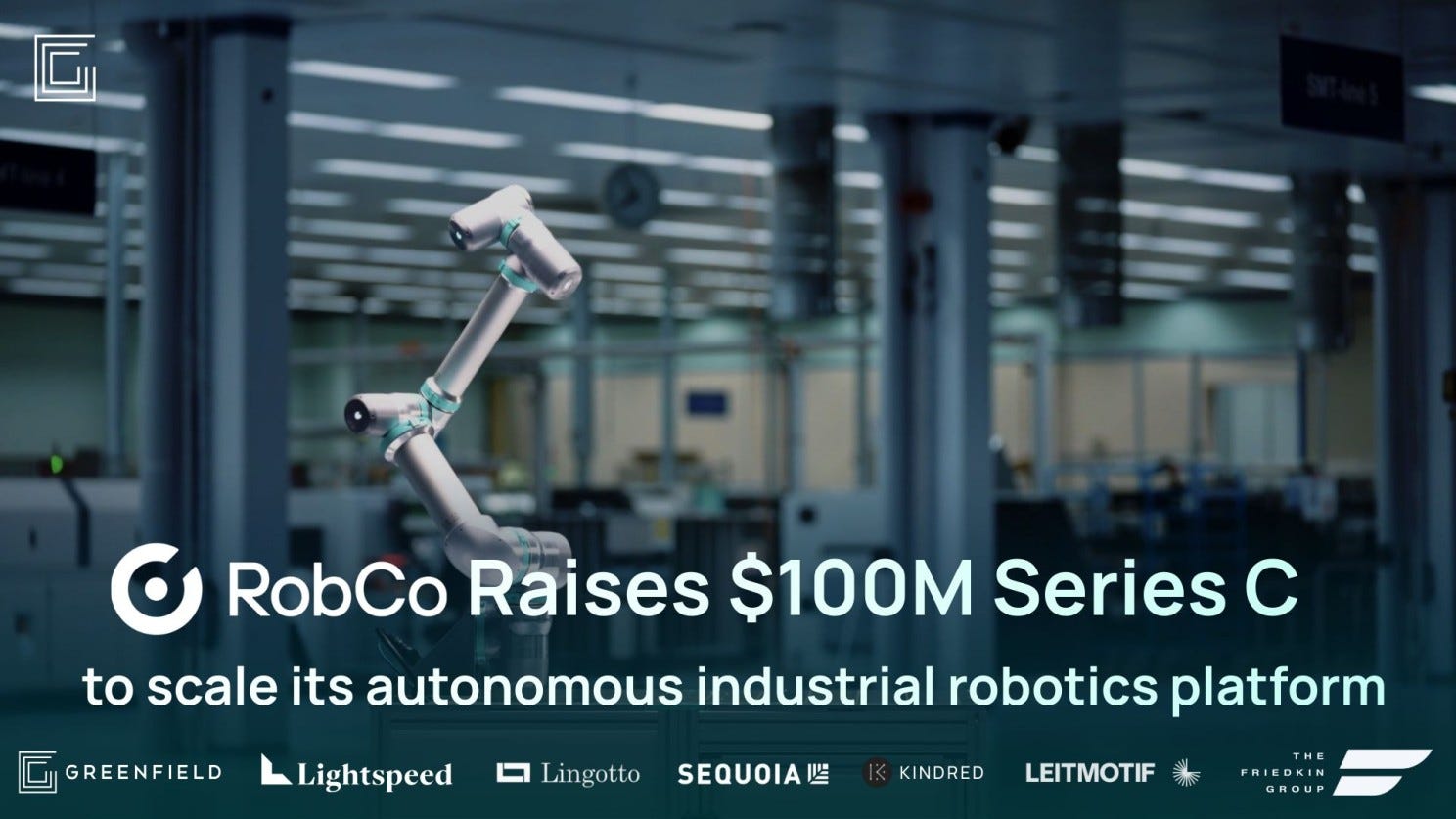
German robotics company RobCo has raised $100 million in Series C funding to expand its autonomous industrial robotics platform across the U.S. and Europe. The round, co-led by Lightspeed Venture Partners and Lingotto Innovation, will be used to accelerate factory deployments and strengthen RobCo’s Physical AI capabilities for real-world manufacturing environments.
The investment reflects a growing focus on robotics systems designed for production floors rather than pilot projects. RobCo’s approach combines adaptable hardware with AI-driven control, positioning the company to address industries looking for automation that can scale across multiple sites and applications.
Why does this matter? This funding round signals strong investor confidence in industrial robotics that move beyond prototypes into repeatable, deployable systems. For manufacturers and automation leaders, it highlights a market shift toward platforms built for long-term operation, integration, and expansion at factory scale.
6 - Vention Raises $110M to Expand AI-Driven Automation Platform
Montreal-based automation platform Vention has raised $110 million in funding to accelerate the global expansion of its cloud-based manufacturing automation platform. The investment will support growth across software, hardware, and partner ecosystems, helping manufacturers design, deploy, and scale custom automation systems faster.
Vention’s approach combines modular automation components with digital design tools and AI-supported workflows, allowing companies to move from concept to production without relying solely on traditional, one-off integration projects. The platform is positioned to support both small manufacturers and multi-site industrial groups looking to standardise automation across facilities.
Why does this matter? This funding highlights a shift toward platform-based automation, where software, digital twins, and modular hardware reduce deployment time and long-term integration risk. For manufacturing leaders, it signals that competitive advantage is increasingly tied to how quickly and consistently automation can be rolled out across operations, not just the performance of individual machines.

Good to Know:
The Robot Queen World Tour 2026 🦾🤖
After the strong response to my on-site visits last year, I’m launching a new regional format for 2026 to connect leading automation companies within the same region and show how robotics actually works inside production, labs, and integration environments.
This is not a marketing shoot. It’s an expert-led way to explain your technology, build trust, and increase visibility with the right audience. I’m collecting interest by region from manufacturing sites, robotics labs, automation and integration teams, and innovation centres. Once a region fills, I’ll share proposed dates, tour format, and participation criteria directly with registered companies.
📩 Register your interest in this link.

Job Offers:
Stay updated with the latest job opportunities in robotics and automation.
Weave Robotics: Robotics Systems Engineer
NACHI EUROPE: Sales Manager – Industrial Robots
Botronics: Senior Robotics Software Engineer
Boston Dynamics: Engineering Change Management Specialist
igus SE & Co. KG: Digital Sales & Marketing Manager
Want more robotics content? 🤖
Watch my videos on YouTube @TheRobotQueen
Follow me on Instagram @therobotqueen_