
The Queen’s Journal – #26
Making robotics easier to understand, smarter to adopt, and safer to scale!

What You Should Know Before Buying a Robot
After defining the real need for automation, the next step is choosing the right level of automation. This can create new problems instead of solving the original one, either by adding unnecessary complexity and maintenance burden, or by leaving bottlenecks and manual workarounds that limit the overall impact of the system.
Over-engineering is common. Systems become complex, expensive, and difficult to maintain. On the other hand, under automating can leave bottlenecks, manual workarounds, and limited gains. The right level of automation is the one that solves the problem without adding unnecessary complexity.
The key is to match automation to the reality of the process. Stable, repetitive tasks usually benefit from higher automation. Processes with variability, frequent changeovers, or human decision making often need simpler, more flexible solutions.
Before deciding the level of automation, check:
How stable and repeatable is the task today?
How often are changeovers or adjustments required?
Who will maintain and troubleshoot the system?
Does added complexity bring real value or just technical appeal?
Automation should support production, not dominate it. The best systems are often the simplest ones that reliably deliver the required result.
➔ Next week: We’ll look at how to choose the right robot type and technology based on the process, not the trend.
Top Robotics Updates
1 - ABB Introduces AI Assistant Inside RobotStudio®
ABB Robotics has introduced an AI Assistant integrated directly into RobotStudio®, its widely used offline programming and simulation platform. The new feature is designed to support engineers during everyday programming tasks by providing contextual guidance inside the development environment, reducing the need to search through manuals or switch between external tools.
The assistant helps users understand RAPID instructions, syntax, and debugging steps, while also supporting faster onboarding for new programmers. Rather than taking control of the robot or automatically deploying code, the system is positioned as a support layer that keeps engineering responsibility with the user. ABB describes the approach as a way to remove friction from robot programming without lowering technical or safety standards.
Explore RobotStudio® with the AI Assistant. Start a 30-day free trial or upgrade to RobotStudio® Premium. 👉Link
Why does this matter? As industrial robots become more capable, the complexity of programming and maintaining them continues to grow. Tools that embed intelligence directly into engineering environments can shorten learning curves, reduce development time, and help teams scale automation without increasing dependency on highly specialised expertise.
2 - New Industrial Robot Safety Standard Now Available
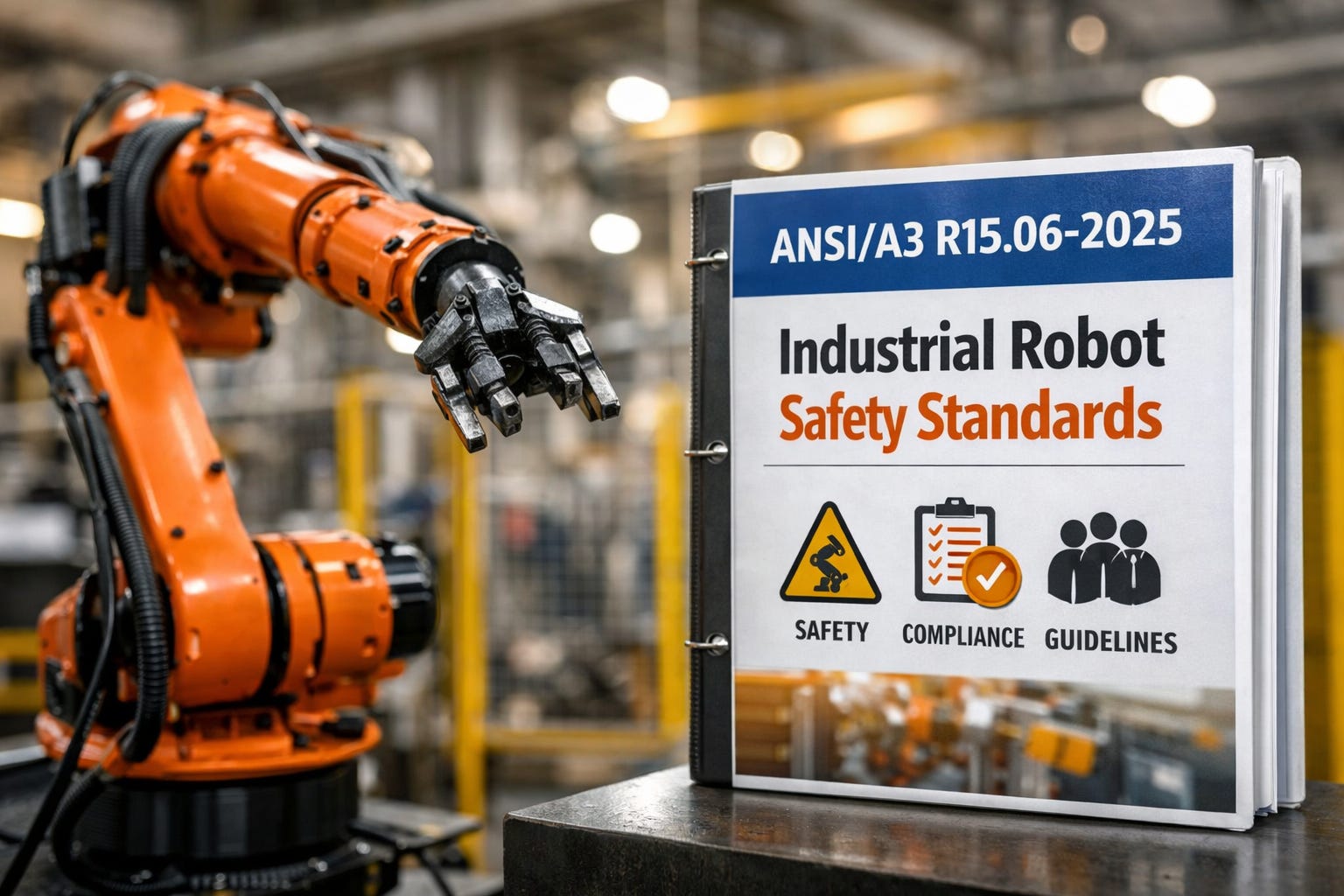
The Association for Advancing Automation announced the full publication of the updated American National Standard for Industrial Robots and Robot Systems, ANSI/A3 R15.06 2025, released on October 29, 2025. The new edition completes a 403 page, three part framework covering safety requirements across the full lifecycle of robot systems, from design and manufacturing to integration and daily operation.
The standard consolidates safety guidance for both industrial robots and complete robot systems, including risk assessment, system testing, and collaborative applications. It reflects how robots are used in modern production environments and brings U.S. safety practices closer to international standards.
➔ The complete three-part standard is currently available for purchase as a PDF download through the A3 online store.
Why does this matter? For companies planning or operating industrial automation, this standard provides a more complete and modern safety framework than previous iterations. Clear safety requirements help organisations make better decisions about robot integration, risk assessment, and safe operation, reducing liability and improving trust in collaborative and autonomous systems. Staying aligned with updated standards also simplifies compliance and can reduce costs associated with redesigns or retrofits as technology evolves.
3 - If Your Robots Learn, Who Is Responsible When They Fail?
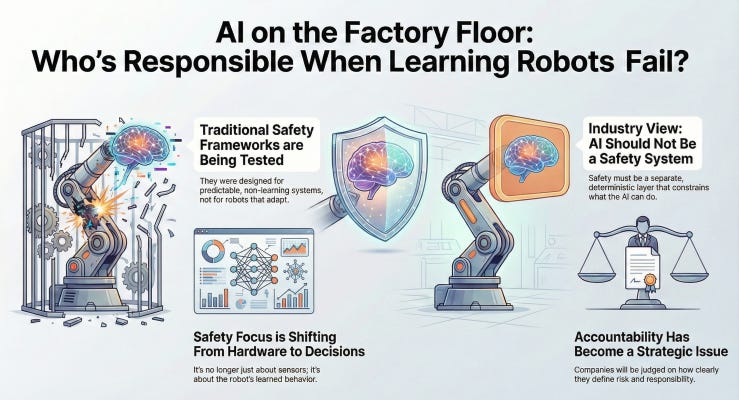
As AI becomes embedded in industrial robotics, safety is no longer just about hardware, sensors, and emergency stops. It is increasingly about decision-making systems that learn, adapt, and change behaviour over time. This shift is challenging how responsibility, validation, and control are defined when robots operate with a degree of autonomy on the shop floor.
Across the industry, a growing view is that AI should not be treated as a safety system. Instead, safety must remain a separate, deterministic layer that constrains what intelligent systems are allowed to do, even when perception or learning models make incorrect assumptions. This thinking also puts pressure on existing safety frameworks, which were largely written for predictable, non-learning systems, and are now being tested by robots that can change how they behave over time.
Why does this matter? As robots move beyond fixed programs and into learning-based operation, accountability becomes a strategic issue, not just a technical one. Manufacturers, integrators, and end users will increasingly be judged not only on what their robots can do, but on how clearly risk, compliance, and responsibility are defined when autonomous systems make decisions in real-world production environments.
4 - Humanoid and Siemens Trial Signals Path to Industrial Use
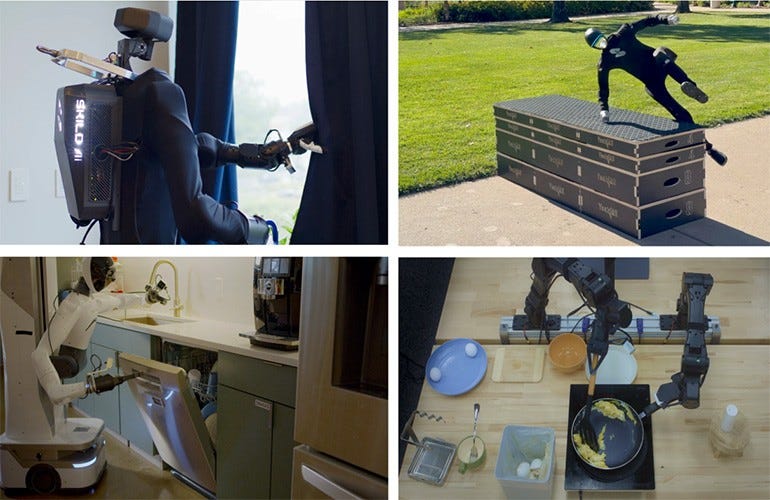
A recent collaboration between UK robotics company Humanoid and industrial technology leader Siemens has demonstrated that humanoid robots can perform real logistics tasks inside an active production environment. In a two-week proof of concept at the Siemens Electronics Factory in Erlangen, Humanoid’s HMND 01 wheeled Alpha robot autonomously handled a tote-to-conveyor destacking task within the facility’s internal logistics flow, achieving success rates above 90% and steady throughput under continuous operation.
The project moved from rapid development using a physical twin to live deployment on the factory floor. During the trial, the robot repeatedly picked totes from storage stacks, transported them to a conveyor, and placed them at designated operator pickup points. Both companies indicated that the results met performance targets and opened the door to further industrial testing and potential expansion to additional sites.
Why does this matter? This milestone indicates that humanoid robots, long seen as promising but largely experimental, are beginning to prove themselves in real industrial workflows, not just laboratories or demonstrations. For manufacturers and automation leaders, this suggests that flexible, general purpose robots may soon complement fixed automation and AMRs in environments where human-like capability adds real value.
5 - Skild AI Raises $1.4B to Build Unified Robot “Brain”
Skild AI, a Pittsburgh-based robotics software startup, has secured 1.4 billion dollars in a funding round led by SoftBank Group, significantly boosting its valuation to over 14 billion dollars. The round also included major strategic investors such as NVIDIA’s NVentures, Bezos Expeditions, Samsung, LG, Schneider Electric, Salesforce Ventures, and others.
Skild AI is developing an “omni-bodied” foundation model for robotics — called the Skild Brain — designed to power a wide range of robots with a single intelligence system. Unlike traditional control models tailored to specific hardware, the Skild Brain is built to adapt to many robot forms, including quadrupeds, mobile manipulators, tabletop arms, and more, without prior knowledge of the robot’s exact physical design. Early applications span security and facility inspection, delivery, warehouse operations, manufacturing, data centers, and construction tasks.
Why does this matter? This level of investment underscores a broader shift in robotics: intelligence and adaptable AI models are becoming as important as hardware. For manufacturers and automation leaders, unified robot brains could reduce the time, cost, and expertise required to deploy robots across diverse tasks, accelerating automation adoption and flexibility across industries.
5 - When Automation Becomes a Company-Wide Strategy
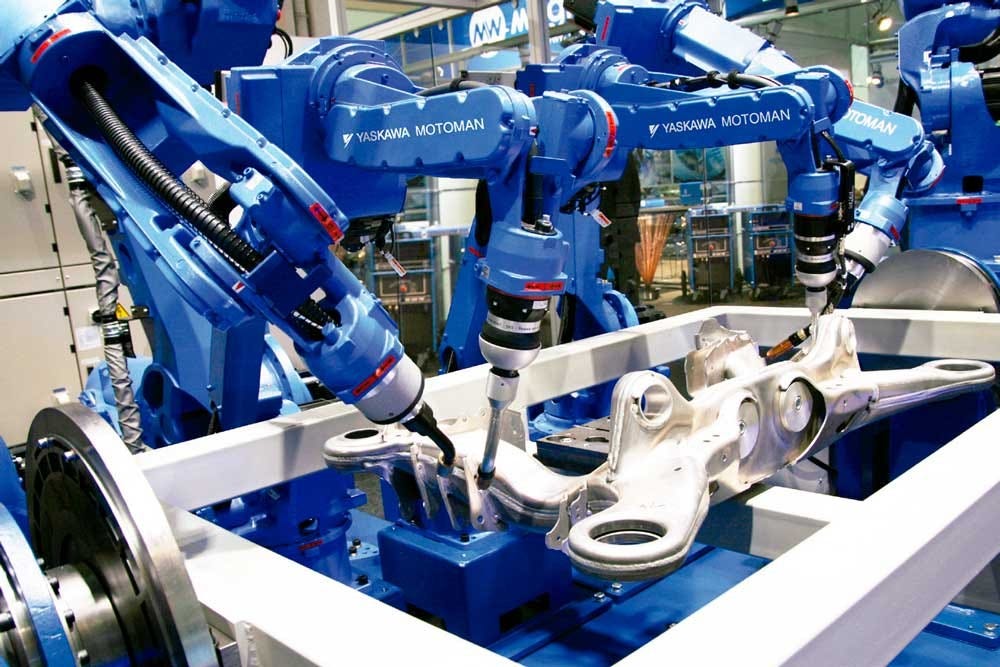
POSCO HOLDINGS has expanded its collaboration with Yaskawa Electric Corporation to accelerate the deployment of industrial robots across its global mobility and manufacturing operations. The move strengthens POSCO’s push toward higher levels of automation in production lines that demand precision, consistency, and scalability.
The partnership focuses on integrating Yaskawa’s industrial robotics and automation systems into POSCO’s facilities, supporting tasks such as material handling, assembly, and process automation. By standardising on a major robotics supplier, POSCO aims to improve system reliability, streamline maintenance and training, and enable faster rollout of automation across multiple sites.
Why does this matter? This signals how large manufacturers are shifting from isolated robot cells to long-term automation strategies. Strategic partnerships with major robot suppliers are becoming a way to scale automation globally, reduce integration risk, and build consistent, future-ready production platforms.
Weekly Tutorial
Programming the Ned3 Pro in Minutes With FreeMotion
This week’s tutorial shows how to create a complete robot program on the Ned3 Pro from Niryo in a few minutes. You do not need to be a specialist or a programmer to get started. FreeMotion mode lets you physically guide the robot and turn simple movements into a working sequence.
What you’ll learn
How to activate Free Drive mode
How to teach and save positions
How to run and refine a full sequence for speed and accuracy
👉 Watch the full step-by-step tutorial.
Good to Know:
Only a few days left to save on the Ned3 Pro
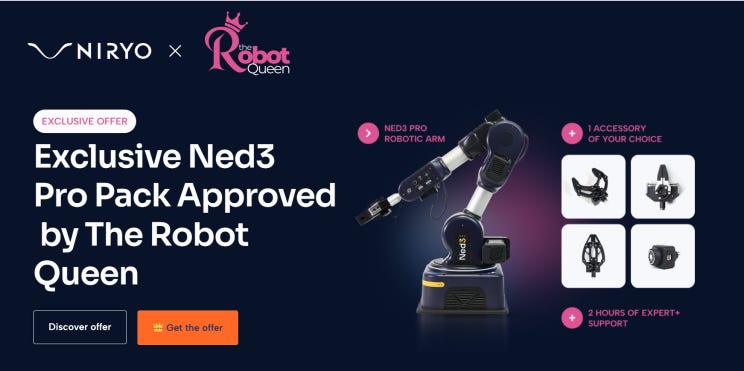
I’m thrilled to share a limited-time 20% off offer in partnership with Niryo. The Ned3 Pro is a compact 6-axis collaborative robot built to make automation easy and accessible in real-world workflows, from pick and place to quality checks and light handling in tight spaces. It’s designed to boost productivity while freeing your team from repetitive work.
Why it’s worth it:
Works in industry, labs or workshops
Automates repetitive tasks and improves quality control
Easy to program and integrate
500 g payload / ±0.3 mm precision / 500 mm reach
This is the perfect moment to integrate a capable cobot into your workflow, offering real value and support included.
👉 Claim your 20% off before January 31, 2026, using this link.
🎁 GIVEAWAY TIME 🤖
igus SE & Co. KG sent me 2 miniatures of ReBeL cobot, and I’m giving 1 of them away to one of my amazing followers. If you love robots, this is your chance to start or grow your robot miniatures collection 🤖
👉Want this ReBeL on your desk? Here’s how.

Want more robotics content? 🤖
Watch my videos on YouTube @TheRobotQueen
Follow me on Instagram @therobotqueen_
Couldn't agree more; this really echoes your last point about understanding the why before diving into automation, although finding that perfect balance alaways feels like a holy grail.